Mingus establishes his empire
The Robot Who Looked Like MeMingus establishes his empire by using a time machine to enter a future Earth divided into small, hostile kingdoms, then taking power in a world he says was ready for centralized organization. His account frames the empire as an answer to disorder and as preparation for a more free and prosperous society; the regime seen elsewhere in the narrative, however, is an extensive police state in which surveillance and Mingus’s exclusive command of time help sustain his authority.
Background and the Future Earth
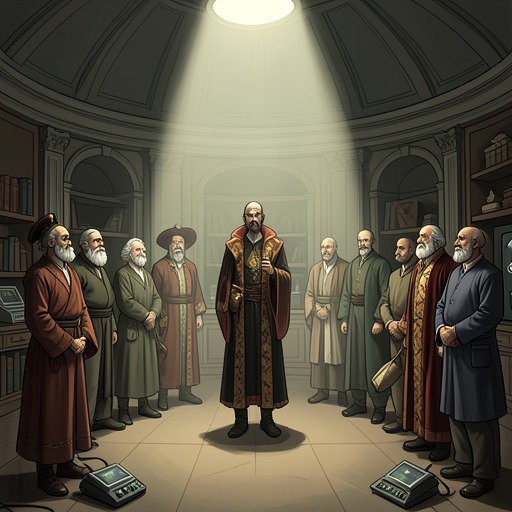
In his address to the Gleisters, Mingus says he invented a time machine and traveled to a distant future. Experiences there shaped the decisions he made afterward. He describes the world he encountered as depleted in both physical and mental resources, broken into small, mutually quarrelsome kingdoms. In that setting, he took over, presenting his rise not simply as an individual ambition but as a response to political fragmentation and social collapse.
Mingus argues that the conditions of the future made organization possible and that he was suited to provide it. His explanation treats political order as contingent: the same methods might not have worked in another time, while the future’s chaos made centralized rule intelligible to its inhabitants. The claim establishes the terms on which he asks his listeners to judge the empire—not against an ideal society in the abstract, but against the disorder he says preceded it.
The contemporary conditions associated with Mingusville give this argument a material setting. Electricity is scarce and expensive, equipment is poorly maintained, and many homes rely on kerosene lighting. Diseases are endemic, and the region had been devastated by cholera and bubonic plague six years earlier. The city’s central market faces immense police barracks, while beggars remain visible despite the Emperor’s prohibition. These details do not erase the security Mingus claims to have provided; they make clear that security and prosperity are not the same achievement, and that the world under his rule remains materially deprived.
Consolidation and the Time Machine
Mingus’s time machine gives the takeover an unusual source of political power. It allows him, within natural limits, to return to an earlier point and correct events that have gone wrong. As the account explains, he can use this capacity against opponents by seeking them before they become underground leaders—even, in the example given, when they are still children. Political resistance is therefore not only something the regime tries to discover in the present: the machine lets Mingus reach backward toward the circumstances from which resistance might develop.
The machine’s decisive limitation is also what keeps it in Mingus’s hands. He must operate it himself and cannot entrust it to another person, because someone else could travel back, kill him, and take the throne. This constraint makes the instrument both the foundation of his extraordinary authority and a source of personal vulnerability. The empire’s temporal advantage is not a transferable institution; it depends on the Emperor’s own continued command of the machine.
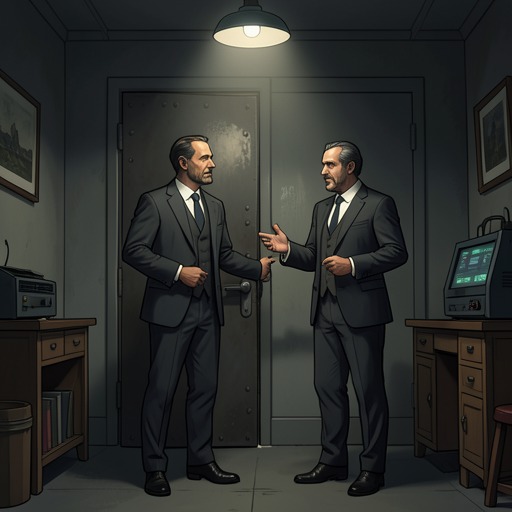
That dependence coexists with a broad apparatus of ordinary surveillance. The regime uses cameras and recorders, accumulates miles of film and tape, and assigns layers of people to monitor one another, with Mingus as the ultimate monitor. The time machine does not make this system unnecessary. Instead, the surveillance organization searches for enemies whom Mingus cannot personally eliminate through time travel. The two means of control divide the work: one reaches backward against certain threats, while the other watches for those who remain beyond its reach.
Mingus’s Defense of Imperial Rule
Mingus acknowledges that his empire resembles a twentieth-century Latin American or African dictatorship, but argues that this appearance must be measured against the chaos from which it emerged. In his account, there had been no peace and strength had been the only recognizable law. He says he provided a measure of security and continuity from which civilization could be rebuilt. His defense thus depends on a contrast between coercive order and prior disorder, rather than on a claim that the empire already embodies political freedom.
He describes peace and prosperity as aims, and political freedom as a future possibility to be granted when people have acquired the intelligence and self-control to use it. He rejects the idea that democracy is natural or immediately workable under the conditions he encountered. The future’s inhabitants, as he characterizes them, accepted steep social hierarchy: serfs and slaves, robber-barons, and a ruling class that treated justice as its exclusive privilege. He argues that appeals to equality would have seemed alien and threatening to people whose political instincts favored allegiance to a single leader.
This argument exposes the contradiction at the center of the imperial project. Mingus says he wants to educate the population in freedom and responsibility, yet he also insists that they are not ready to exercise political freedom. He claims that a token democracy would have collapsed as soon as its founder lost physical control, and presents authoritarian organization as the only political form the population could understand. The empire is therefore defended as a bridge toward freedom, but the power to decide when that bridge has been crossed remains with the ruler who built it.
Resistance and the Empire’s Continuing Conflict
Mingus’s account also explains why his rule does not end political opposition. The Gleisters, whom he calls his alter egos and brothers, repeatedly emerge from the past intent on assassinating him. He says he tried to kidnap some of them and re-educate them, but their numbers and the dynamics of the situation worked against him. His own explanation makes the resistance inseparable from the time machine: the same movement through time that gives him extraordinary power brings versions of his opponents into conflict with him.
Unable to defeat every Gleister through direct intervention, Mingus learns about their organization, returns, and infiltrates it. By the time he addresses them, he says he has taken it over and asks them to cooperate in his project of transforming Earth. The speech is consequently more than a retrospective defense of his accession. It is also an attempt to secure cooperation from the very opposition that has repeatedly threatened him, even as his earlier methods—surveillance, abduction, re-education, and infiltration—show how little room the empire leaves for resistance outside the ruler’s control.
The establishment of the empire remains unresolved in moral and political terms. Mingus presents it as a practical answer to a fractured, violent future and as a foundation for eventual freedom; the evidence also shows that its security rests on pervasive monitoring, a ruler’s personal monopoly over time travel, and continuing efforts to suppress or absorb opposition. The gap between the promised destination and the means used to reach it is central to the event’s significance.